
Closing the Welfare Gap
Good intentions do not always lead to good welfare outcomes.
The Species First Welfare Gap Framework describes the difference between intended care and the welfare actually experienced by the animal.
Understanding the Framework
Across a wide range of species, we continue to see animals that struggle to feed, move, behave naturally or thrive - even where owners are dedicated and clearly care deeply.
This suggests that welfare outcomes are not determined by commitment alone, but by how multiple interacting welfare pillars align around the needs of the individual animal.
Closing the Welfare Gap requires understanding and aligning the full set of conditions that allow an animal to function well.
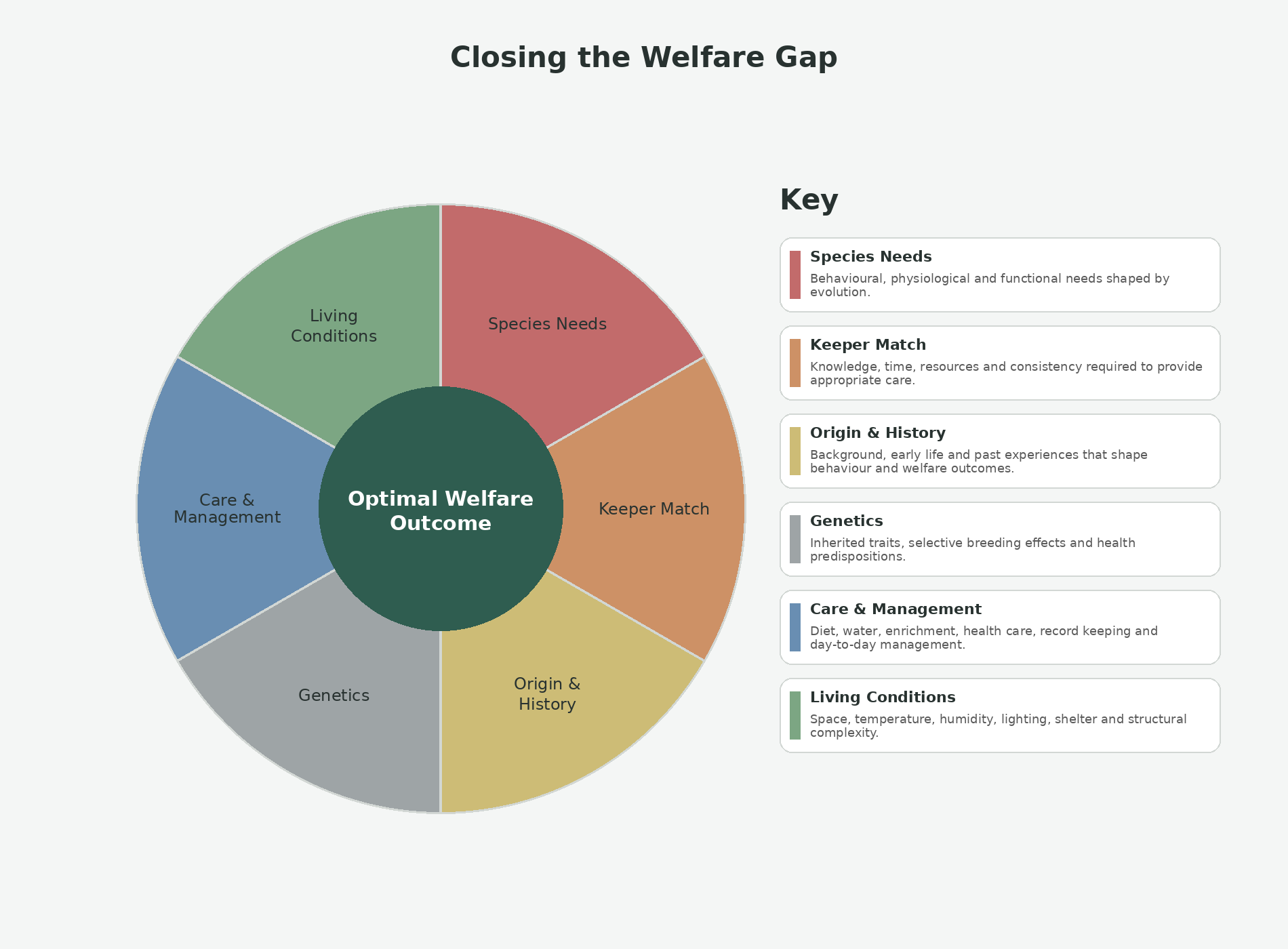
The Species First Welfare Gap framework is structured around six interdependent welfare pillars that collectively shape the likelihood of positive welfare outcomes in captivity.
Weakness, instability or incompatibility in one pillar can undermine the overall welfare outcome - even where other pillars are well addressed.
The framework complements existing welfare models, including the Five Domains Model, by extending consideration beyond the animal’s immediate experiences to include:
genetics,
origin and history,
current scientific and practical understanding of the species’ needs, informed by how it lives in the wild,
keeper match, including knowledge, capability, time, consistency and resources,
and the realistic feasibility of meeting species-specific needs in captivity.
Exploring the Six Welfare Pillars
Each pillar influences the welfare outcome of the individual animal and interacts with the others to shape overall welfare.
Understanding these interactions is essential for closing the welfare gap.